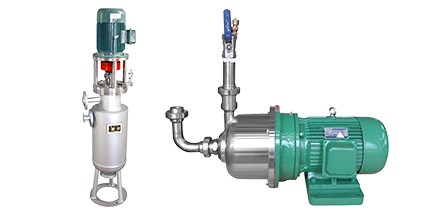
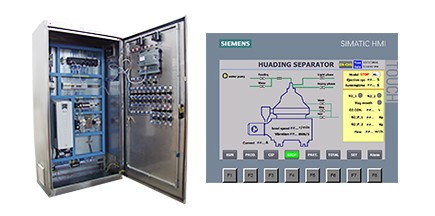
Separator & Decanter Centrifuge Equipment
Huading provides reliable industrial separation equipment for concentration, purification, clarification, dewatering, and solid-liquid separation applications.
Since 1954, Huading Separator has been dedicated to the research, development, and manufacturing of industrial separation equipment. Our product portfolio includes disc separators, decanter centrifuges, tubular centrifuges, filters, mixers, automation systems, and multi-disc screw presses. Huading separators and decanter centrifuges are widely used in a variety of industries, including food and beverage, chemical processing, pharmaceuticals, dairy, environmental protection, energy, oils and fats, and starch and protein processing.
Huading equipment is designed for demanding industrial processes, helping customers improve separation efficiency, product quality, and process reliability. By using high-speed centrifugal force, our equipment effectively separates liquids and solids with different densities. Depending on the specific process requirements, Huading equipment can be used for liquid-liquid separation, liquid-solid separation, liquid-liquid-solid separation, clarification, concentration, dewatering, extraction, and classification.
We offer a wide range of equipment models and customized solutions to meet different requirements for processing capacity, material characteristics, automation level, and production workflow. Whether you need a standard centrifuge or a complete separation system, Huading can provide a reliable solution tailored to your application.

Under the impact of the centrifugal force,centrifuges are able to clean and separate or clarify liquids or to remove solids from liquids while making use of the physical gravity laws.
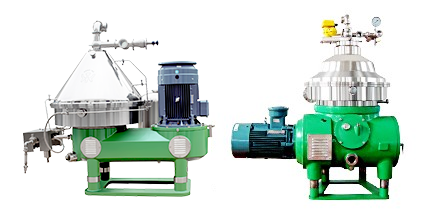
separators are designed for separating solids and one or two liquid phases from each other in one single continuous process, using extremely high centrifugal forces. eg. liquid-liquid-solids separation, liquid-solids separation, liquid-liquid separation.
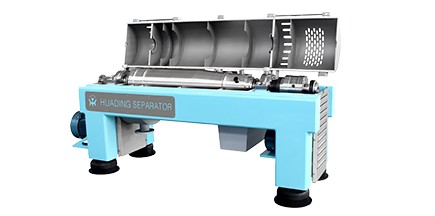
Separating Solids and Clarifying Liquids. Extraction, concentrating, dewatering and classifying.
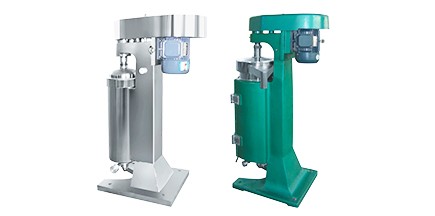
Continuous separation of liquids from liquids or of very fine particles from liquids, thanks to its ultra strong centrifugal force.
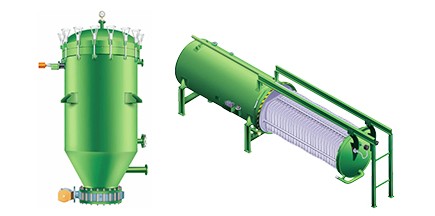
In terms of the difference of particle size,selecting appropriate filter medium,solid-liquid separation is achieved by the filtration process.
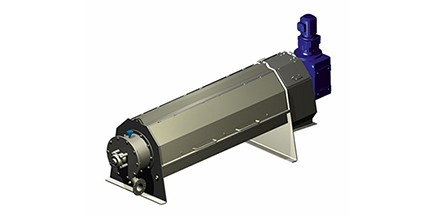
Huading multi-plate screw press are specially designed for dewatering of sludge from water and wastewater treatment, biogas residue and industrial slurries.
Centrifugal Separation Technology is the most widely used method for separating fluids with different densities. It is also used in separating solids from liquids or solids from gasses.
The need to separate different liquid phases and solids from each other is part of practically every industrial process. Huading Separator has more than half a century of experience in meeting this requirement using either separator or decanter technology. And our products perform this crucial function exceptionally well.
The product range is based on centrifugal separation machines for separating liquids from each other or for removing solid particles from liquids. All these centrifugal separation machines are based on density difference.
A centrifuge can be understood as a settling tank that rotates at high speed. Instead of relying only on gravity, it uses centrifugal force to accelerate separation.
As the bowl rotates, materials with different densities move to different positions inside the bowl:
This process allows centrifuges to separate materials quickly, continuously, and with high accuracy.
Sedimentation
Terminal free settling velocity of a spherical particle under gravitational force can be determined by the Newton’s law:

Where
u, m/s settling velocity
d, m particle diameter
g, m/s2 acceleration of gravity
ρ1 Kg/m3 density of particle
ρ2 Kg/m3 density of liquid
CD drag coefficient
CD has been found to be a function of Reynolds Number. If the flow around the particle is laminar Re < 0.6 then CD =24/Re. In this case, we can reduce the equation of settling velocity to :

Where
u , m/s settling velocity
d, m particle diameter
g, m/s2 acceleration of gravity
ρ1, Kg/m3 ensity of particle
ρ2, Kg/m3 ensity of liquid
μ, Pas fluid dynamic viscosity
This expression is the Stoke’s law of the terminal settling velocity of a spherical particle under laminar flow conditions.
Centrifugation
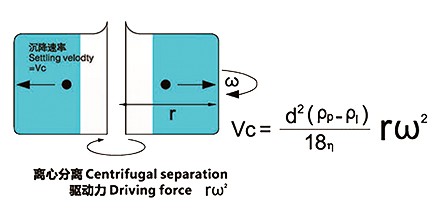
If the settling is carried out in a centrifugal field instead of gravitational, then we have to deal with a centrifugal acceleration, which is not constant like “g”, but increases as the distance of the particle from the axis of the rotation of the vessel and as the angular velocity (See Fig .1.). Sedimenting centrifuges use centrifugal force to accelerate the sedimentation process. By rotating the process fluid, the sedimentation rate can be increased by a factor of several thousands compared to static sedimentation or settling. In applications, in which centrifuges are used, the static sedimentation velocity is between 10-9 and 10-4 m/s. To accelerate the process, centrifuges apply centrifugal forces of 500-30000g.

Fig.1. Principal analogy between sedimentation and centrifugation
The factor Z= rω2/g specifies how much greater the sedimentation rate of a particle is in a centrifugal field as compared with the gravitational field.
The next figure illustrates a centrifugal separator for removing solid particles from liquids.

Accelerating the separation process
In essence, a centrifuge is a settling tank whose base is wrapped around a centre line. Rotating this entire unit rapidly means that the effect of gravity is replaced by a controllable centrifugal force that can have an effect up to 10,000 times greater.
This force is then used to separate liquids from other liquids and solids efficiently and with great accuracy, and in a manner that is easy to control.

In the centrifugal field, under the action of centrifugal force, when the denser solids are subjected to centrifugal forces, they are forced outwards against the rotating bowl wall, while the less dense liquid phases form concentric inner layers
Centrifugal force
Centrifugal separating technology utilizes fundamental physical laws and centrifugal force.
Centrifugal force is produced through rotation around an axis. The force generated through the rotation acts in an outward direction. Depending on the speed of the rotating body, it increases or drops on the circular path.
Mechanical separation technology makes use of this property when light, heavy or substances of different density have to be separated from each other.
Centrifugal forces in a vessel
The centrifugal forces act on all particles. The particles with the specifically higher weight are spun outwards fastest and most effectively. They then deposit on the edge of the vessel.
Separation by means of centrifugal force is, however, faster when the vessel has an insert. Thanks to the insert, the specifically heavier particles deposit faster. The settling path is shortened by the insert. By this means, a higher throughput capacity is attained.
This means: larger volumes of liquid mixtures can be clarified or separated in the same period of time. The more inserts there are, the shorter the settling paths and the higher the throughput capacities.
Huading provides disc separators, decanter centrifuges, tubular centrifuges, filters, mixers, automation systems, and multi-disc screw presses for different industrial separation applications.
A centrifuge is used to separate materials with different densities. It can separate solids from liquids, liquids from liquids, or multiple phases in one continuous process.
A separator is usually used for high-speed clarification and liquid-liquid or liquid-solid separation, while a decanter centrifuge is more suitable for materials with higher solid content and continuous solid discharge.
The right equipment depends on material characteristics, solid content, particle size, required capacity, separation goal, and automation requirements. Huading can help evaluate your process and recommend a suitable model.
Yes. Huading offers customized separation equipment and complete separation systems based on different processing capacity, material properties, automation requirements, and production workflows.
Huading has supplied centrifuge and separation equipment to customers around the world. From plant extraction to chemical separation, from clarification to sludge dewatering, and from low-capacity processing to large-scale production, Huading provides reliable solutions for demanding separation processes. If you are not sure which equipment is suitable for your material, our technical team can help evaluate your process and recommend the right solution.
Talk to us