
Separation Efficiency
Dec 05,2025
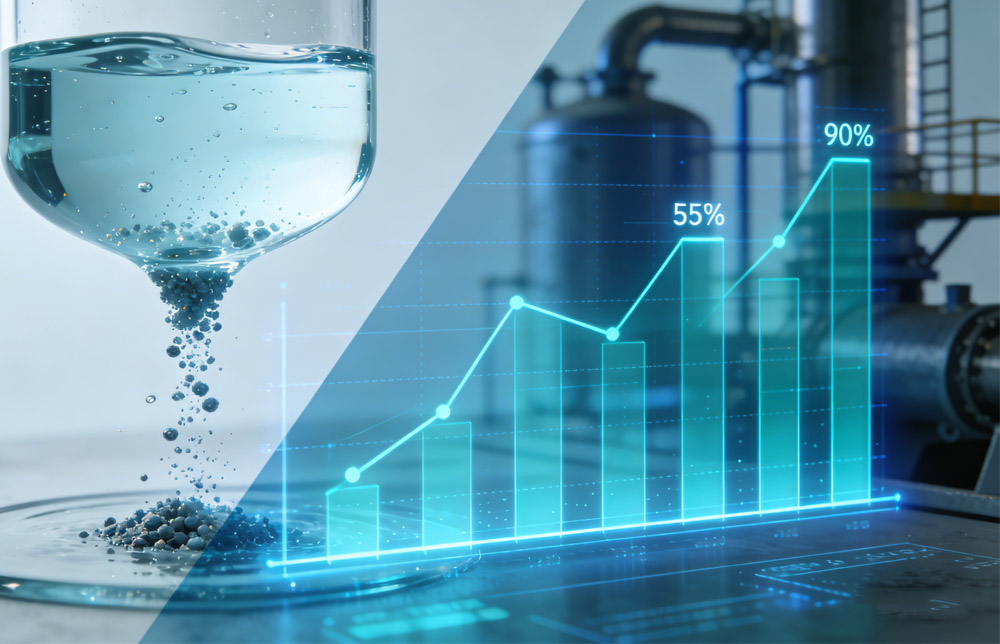
Separation efficiency is a key performance metric in chemical and process engineering. It describes how effectively a system divides a mixture into the desired product phase and the residual phase. In industrial separation equipment, high separation efficiency reflects a balance of product quality, operational stability, and cost-effectiveness.
Higher efficiency means fewer impurities remain in the product stream and less product is lost to waste or contamination. For processes handling chemical slurries, fine suspensions, or multiphase liquid systems, improved efficiency leads to cleaner outputs, reduced recycling or reprocessing needs, and better use of raw materials.
What Influences Separation Efficiency?
Phase behavior and residence time
Components must be given adequate time and force to separate. Bowl design, disc-stack geometry, and screw configuration play direct roles in how fluids and solids stratify.
Separation force
Greater centrifugal force accelerates settling and phase separation. However, viscosity, solids concentration, and feed flow rates all affect real-world outcomes.
Feed characteristics
Dense slurries, emulsions, and fine particles demand more advanced separation designs. Efficiency depends on particle size, density differences, and fluid properties.
Output quality
Efficiency is typically assessed by evaluating liquid clarity, solid dryness, and product recovery. These three metrics are practical indicators of the overall performance of the separation system.
Why Separation Efficiency Matters?
In chemical and industrial processing, mixtures often contain high solids content, dissolved compounds, or multiple liquid phases.
Poor separation efficiency can result in:
- Higher impurity levels
- Lower product quality
- Increased energy and water consumption
- Greater wear on downstream equipment
- Higher environmental impact
Efficient separation leads to cleaner streams, more stable production, and better utilization of resources.
How to Improve Separation Efficiency?
Engineering teams can enhance separation performance through:
1. Matching equipment to feed characteristics
Select equipment designed for the solids content, viscosity, and phase composition of the material stream.
2. Controlling feed conditions
Regulate feed rate, temperature, and pretreatment to ensure optimal conditions at the inlet of the separator.
3. Adjusting operating parameters
Tuning bowl speed, differential speed, discharge intervals, and torque settings can significantly improve efficiency.
4. Maintaining equipment cleanliness and alignment
Build-up, wear, and misalignment can degrade performance. Regular maintenance ensures consistent operation.
5. Monitoring performance metrics
Routinely analyse feed and discharge streams for clarity, solids content, dryness, and recovery rate to guide process adjustments.
Integrating High-Efficiency Separation
Effective separation is not only about choosing the right machine, but it’s also about integrating it properly. Good system design ensures stable upstream conditioning, real-time adjustability, and proper maintenance planning.
When implemented correctly, high-efficiency separation supports:
- Better product purity
- Lower waste and disposal costs
- Improved solvent and water recovery
- Higher overall process reliability
Conclusion
Separation efficiency is fundamental to modern process industries. By understanding the factors that affect it and by selecting and operating the right separation equipment, you can significantly improve productivity, product quality, and long-term sustainability.
--- END ---
Prev: Inertization


