
Stokes’Law
Apr 20,2026
Stokes’Law is a fundamental principle in fluid mechanics that explains how small spherical particles move through a viscous fluid. It is widely used in separation technology, sedimentation analysis, and process engineering to estimate particle settling behavior under laminar flow conditions.
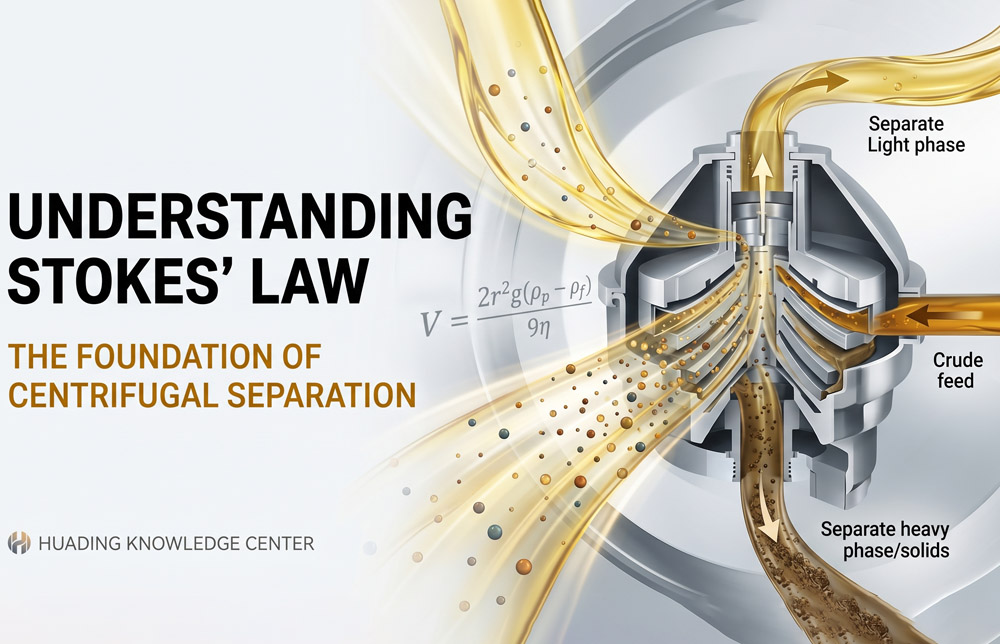
What is Stokes’ Law?
Stokes’ Law describes the drag force acting on a small sphere moving slowly through a fluid:
F = 6πμrv
Where:
F is the drag force
μ is the fluid viscosity
r is the particle radius
v is the particle velocity
This relationship shows that drag increases linearly with velocity when flow is smooth and orderly.
Conditions for Applying Stokes’Law
Stokes’ Law applies only under specific conditions:
- Particles are small and spherical
- Flow around the particle is laminar (Reynolds number < 1)
- Viscous forces dominate over inertial forces
When these conditions are met, the law provides reliable predictions of particle behavior.
Practical Applications
Stokes’ Law is widely used in industrial and engineering processes, including:
- Sedimentation and clarification in water and wastewater treatment
- Solid–liquid separation in centrifuges and clarifiers
- Emulsion separation, such as oil–water systems
- Particle size estimation in laboratory analysis
It helps engineers estimate separation efficiency and optimize equipment design.
Why Stokes’Law Remains Important?
Stokes’ Law provides a clear and practical framework for understanding particle motion in fluids. Even today, it serves as the foundation for many modern separation and fluid dynamics models used in industrial processing.
--- END ---
Prev: Throughflow
Already the latest article


