High speed separation & clarification. GF series Tubular Centrifuge from Huading Separator is a high speed solid bowl type machine for continuous separation of two immiscible liquids with density difference. This centrifuge is also used to separate small quantity of impurities from liquids.
The tubular centrifuge is consisted of frame body, driving device, bowl and motor.
GF tubular centrifuge is designed to separate two (2) immiscible liquids of differing densities. The high centrifugal force generated causes the high density liquid to migrate toward the tube wall while the lower density liquid is displaced to the center of the tube. The separated liquids are then discharged at the top of the tube with dedicated outlets.
Huading continually raises the bar in bag filter technology. Providing the widest range of bag filters for any baghouse collector, Huading offers various bags.
Huading bag filters tend to have the lowest equipment investment costs, and are generally tolerant of a wide range of process conditions, making them a good choice for a wide range of applications.
Careful consideration, when choosing a liquid filtration system, will offer numerous potential benefits. A wise filter selection can minimize process downtime, reduce or eliminate waste disposal costs, limit worker exposure to the process liquid, reduce maintenance time and expense, and improve product quality.
Vertical Pressure Leaf Filters are quite similar to the Horizontal Plate Filters except for the orientation of the filter elements which are vertical rather than horizontal. They are applied for the polishing slurries with very low solids content of 1-5% or for cake filtration with a solids concentration of 20-25%.
Just like the Horizontal Plate Filter the Vertical Leaf Filters are also very well suited for handling flammable, toxic and corrosive materials since they are autoclaved and designed for hazardous environments when high pressure and safe operation are required. Likewise, they may be readily jacketed for applications whenever hot or cold temperatures are to be preserved. These features are not possible on Filterpresses which require the opening of plates to the atmosphere and shifting them one by one to allow cake discharge at the end of each cycle.
The largest vertical pressure Leaf Filters have a filtration area of 90 m2 and designed for an operating pressure of 6 bar
The slurry is pumped under pressure into a vessel that is fitted with a stack of vertical leaves that serve as filter elements. Each leaf has a centrally located neck at its bottom which is inserted into a manifold that collects the filtrate. The leaf is constructed with ribs on both sides to allow free flow of filtrate towards the neck and is covered with coarse mesh screens that support the finer woven metal screens or filter cloth that retain the cake.
The space between the leaves may vary from 30-100 mm depending on the cake formation properties and the ability of the vacuum to hold a thick and heavy cake to the vertical leaf surface. The space is set by the filtrate necks of the leaves at the bottom end and with spacers at the top end brackets.
For fast filtering slurries the space may be doubled by removing every second plate so consequently the cake space doubles but the filtration area is cut in half.
━ High filtrate clarity
━ High yield low product losses
━ Large filtration area – small footprint (high headroom)
━ No filter cloth – no washing or cloth replacements
━ Totally enclosed operation – no contact with air/moisture
━ Positive pressure – no vacuum or lowered pressures necessary
━ Wet or dry cake discharge
━ Possible extraction of the filter cake within the filter
━ Easy to automate – operation with minimum labour
━ Fast and effective cleaning without manual interference.
━ Mechanically simple
━ Easy access to the filter leaves for maintenance or extra leaf cleaning
━ Intensive cleaning of filter medium is possible
━ Improved housekeeping
━ Steam heating optional
Horizontal Pressure Leaf Filters are ideal for batch process applications requiring high flow rates with low solids removal. Horizontal Pressure Leaf Filter consists of the horizontal tank with a removable cover. For sealing of the framing joint and the cover a spacer is used, which is tightened by turning of a bayonet-type ring by means of two hydrocylinders of the valve. Taking of the cover is performed by means of the hydrocylinder also.
The horizontal vessel orientation is the most common type of pressure leaf filter. This arrangement allows for the greatest filtration area. Vessel sizes are available up to 2000mm in diameter providing up to 200 m2 of filtration area. All horizontal filters use vertical filter leaves.Our filters are custom built & optimized for each application, and are specifically engineered to operate with the minimum amount of maintenance.
The horizontal pressure leaf filter is an enclosed filtration system and can be fully automated. This filter produces a high filtrate clarity after the clarification run and is also suitable for all kinds of filter aids. The regeneration time between the filtration cycles is short. Horizontal pressure leaf filters can also be delivered as tandem units to save floor space. The pressure leaf filter itself has no rotating parts, keeping maintenance to a minimum. These advantages result in an economical filtration solution.
Various materiel are available, eg. stainless steel, carbon steel with rubber, PP, PVDF lining, monel, inconel , etc. ‘O’ ring sealing are available in BUNA-N, Viton, EPDM, Nitrile, Silicon etc.
Features:
━ Horizontal Configuration
━ Filtration areas up to 200 M2
━ Manual to fully automatic operation
━ Designed for PLC automation
━ Movement of shell by hydraulic power pack
━ Suitable for dry or wet cake discharge
━ Wide range of leaf materials and construction
High-speed separation & clarification. GQ series Tubular Centrifuge from Huading Separator is a high-speed solid bowl type machine for continuously removing solids from liquid with density difference.
GQ tubular centrifuge is designed to separate low percentages of solids between 1 and 0.001 microns in size which are suspended in a liquid. The high centrifugal force generated causes the solids to migrate to the wall of the centrifuge tube where they are retained. The clarified liquid is discharged at the top of the tube.
A tubular centrifuge is an ideal instrument in biology, traditional medicine preparation, health food, and chemistry for liquid-solids separation. It is specially designed for the separation and clarification of process liquid with a low-density difference, small granularity, low solid content, and strong medium corrosion.
Disc separator with SIP&CIP is designed for aseptic processes, which is becoming increasingly important for handling sensitive products in the pharmaceutical, biotech and food industries. This is applicable for instance for the separation of proteins from fermentation solutions for pharmaceutical products, processing genetically modified micro-organisms or manufacturing starter cultures in the food and pharmaceutical industries, production of vaccines or the processing of genetically modified organisms. Phase separation by means of centrifugal force in a separator is a key aspect in the process involved. And this important step in the process must also take place under sterile conditions. This means that the entire separator system must be steam-sterilizable. All plant components such as fermenters and receiving tanks for the separated components are connected aseptically to the system.
Huading Separator has developed the clarifier BTSX-M series in steam-sterilizable design (SIP) specifically for these fields of application which has an hourly throughput capacity of 100 to 10,000 liters based on E-Coli. The new disk type separator is suitable for the continuous clarification of suspensions, separating bacteria, mammalian cells, cell fragments and yeast under sterile conditions.
The complete disc separator with SIP&CIP is steam-sterilizable. The machine is sterilized at rotate using superheated steam at overpressure of 2.5 bar and a maximum possible temperature of 137 °C. After sterilization, the separator is blanketed with sterile air, which also cools down the machine, until the next product run. Sterilization avoids cross-contamination between different fermentation products which are treated in the same separator. Chemical cleaning in place (CIP) is carried out before the sterilization process (SIP). Cleaning liquid is circulated through the separator and the connected system.
A further aspect in the recovery of proteins in the separator is just as important as the prevention of product contamination: the guarantee of biocontainment. Therefore, Huading Separator offers the BTSX-M in steam-sterilizable design as an absolutely enclosed machine and plant concept which prevents toxic bacteria or living cell vaccines from escaping into the atmosphere.
The product is separated into solids and clarified liquid in the disk stack and discharged foam-free and under pressure by centripetal pumps. The solids accumulate in the solids holding space and are instantaneously ejected at periodic intervals and collected in the solids tank. The solids can be further transported from the solids tank by means of pumps. The BTSX-M series is equipped with a metering piston which permits precise preselectable and reproducible ejections. A twin-action slide ring packing reliably separates the drive chamber from the chamber which comes into contact with the product so that possible contamination of the product by motor and gear are excluded.
The required drive power for the type BTSX-M disc separator with SIP&CIP separator is transmitted by a three phase AC motor via a flat belt or gear worm direct onto the bowl spindle. The advantage of the flat belt drive is the reduced maintenance requirement and hence higher availability and less downtime. The hood as well as the solids collector are in two-wall design to cool the recovered proteins.
A major advantage of using the BTSX-M separator in these demanding processes is the high degree of automation. Irrespective of whether the separators are used as a stand-alone insular control facility or are incorporated in a master process control system – different recipes, ejection intervals, the biomass harvest as well as the SIP and CIP phases can be carried out in a reproducible and error-free manner at the push of a button.
Applications include:
– insulin
– monoclonal antibodies
– blood-derived products
– vaccines
– sera
– starter cultures
– pharmaceutical proteins
– animal cell cultures
– hormones
other applications, such as E-Coli, inclusion bodies and mammalian cells starter cultures, such as lactic acid bacteria, fermentation broth and enzymes treatment of genetically engineered microorganisms.
The BTSX-M series separator incorporates a number of important product features:
– CIP and SIP (steam-sterilizable) up to 2.5 bar steam pressure (137°C) (ASME available)
– Operates at 16,000 g
– Gentle treatment of shear-sensitive microorganisms
– Precisely controlled partial and full solids ejections, which reduces the solids ejection time to less than 1/10 of a second and results in an increase in cake dryness.
As a supplier of sterile process plant with many years of experience, Huading Separator can draw upon the comprehensive theoretical knowledge and expertise of its engineers to provide modern, bespoke and cost-effective disc separator to manufacture new medicines according to cGMP guidelines and US FDA, SFDA and EMA requirements.
The Huading Chamber Bowl Separator is a solid-bowl centrifuge equipped with annular inserts (chambers). Its design features a cylindrical bowl housing multiple nested concentric cylinders, effectively increasing the separation surface area. This configuration enhances the separator’s ability to remove fine solids from suspensions, making it ideal for applications requiring high-purity outputs.
During operation, the suspension flows through the individual chambers from the inside to the outside. Solids are deposited within these chambers, while the clarified liquid is discharged either under gravity over an overflow weir (regulating ring) or under pressure via a centripetal pump.
Key Features
Enhanced Separation Efficiency: The inclusion of multiple concentric chambers increases the effective separation area, improving the removal of fine solids.
Versatile Discharge Options: Offers both gravity-based and pressure-based discharge methods to suit different process requirements.
Manual Cleaning: Designed for processes where manual removal of accumulated solids is feasible and acceptable.
Robust Construction: Built with high-quality materials to withstand demanding operational conditions and ensure longevity.
Compact Design: The separator’s compact footprint allows for easy integration into existing processing lines.
Low Maintenance: Simplified design with fewer moving parts reduces maintenance requirements and downtime.
Applications
Blood Processing
Huading Chamber Bowl Separator is adept at handling blood plasma fractionation processes, such as the Cohn process, which requires maintaining low temperatures for plasma fractionation and ensuring consistent performance across varying volumes. Its robust cooling system supports consistent fractionation. Additionally, Huading provides standardized and custom automation solutions, enhancing the functionality and reliability of the centrifuge in various operational contexts.
Pharmaceutical and Biotech Industries
The Chamber Bowl Separator is widely used in pharmaceutical and biotech applications for the clarification of liquids where the separated solids must be removed manually. Its design allows for the efficient separation of fine solids from suspensions, making it suitable for processes such as the purification of vaccines, antibiotics, and other sensitive biological products. The separator’s gentle handling ensures the integrity of delicate biomolecules, while its robust construction meets the stringent hygiene standards required in pharmaceutical manufacturing.
Additional Applications
Beverage Industry: Clarification of beer and other fermented beverages to achieve desired clarity and stability.
Biodiesel Production: Removal of impurities and particulates to ensure fuel quality and compliance with standards.
Chemical Industry: Purification of chemical solutions by separating fine solid contaminants, enhancing product quality.
Technical Specifications
Bowl Design: Solid-wall with annular chamber inserts.
The Huading Solid-Wall Separator is a high-speed disc stack centrifuge for the efficient separation of liquid-liquid mixtures and clarification of liquids with minimal solid content (typically less than 2% by volume). Its robust, solid-wall bowl design ensures reliable performance in processes where automatic solids discharge is unnecessary or impractical.
By incorporating a series of conical discs separated by spacers ranging from 0.3 to 2 mm, the separator achieves a substantially larger equivalent clarification area within the same bowl volume compared to chamber bowl separators. This design enhances the separator’s ability to recover fine particles and achieve high-purity outputs.
Solids separated during the process are retained within the bowl and can be removed manually or automatically by intermittent. This feature simplifies the mechanical design, reduces operational complexity.
Key Features and Advantages
High G-Force Separation: The solid-wall design allows for the generation of very high centrifugal forces, enhancing the separation efficiency of fine particles.
Expanded Clarification Area: The use of multiple conical discs increases the effective clarification area, improving throughput and separation performance.
Versatile Applications: Suitable for both liquid-liquid separation and liquid-solid clarification processes across various industries.
Robust Construction: Built with high-quality materials to withstand demanding operational conditions and ensure longevity.
Applications
Dairy Industry
In the dairy sector, the solid-wall separator is utilized for processes such as cream concentration and milk clarification. Its ability to efficiently separate fine particles ensures high-quality dairy products with improved shelf life and taste.
Beverage Production
For beverage manufacturers, particularly in juice and wine production, the separator aids in clarifying liquids by removing suspended solids, resulting in clearer, more appealing products.
Fish Oil and Fish Meal Processing
In the processing of fish oil and fish meal, the separator effectively separates oil from water and fine solids, enhancing product purity and yield.
Pharmaceutical and Biotechnology
The separator is employed in pharmaceutical and biotech industries for the clarification of fermentation broths and separation of biomolecules, where maintaining product integrity is crucial.
Chemical Industry
In chemical manufacturing, the separator assists in purifying liquids by removing trace solids, ensuring the quality and consistency of chemical products.
Technical Specifications
Bowl Design: Solid-wall with conical disc stack.
Separation Process: Liquid-liquid separation and liquid-solid clarification.
Solids Discharge:Intermittent manual or automatic removal
Clarification Area: Enhanced by multiple conical discs separated by spacers (0.3–2 mm).
Material: High-grade stainless steel construction for durability and hygiene.
Nozzle separators are continuous disc centrifuges primarily designed for solid particle separation, with a greater emphasis on solid removal than self-cleaning separators. They are suitable for fermentation and concentration products with high viscosity, high dry matter content, and high protein content. Nozzle separators are widely used for classifying solid particles, solid dehydration, washing, and clarifying liquids with high solid concentrations. They can also be used for three-phase separation, simultaneously separating two liquid phases and one solid phase. When configured as clarifiers, nozzle separators are referred to as concentrators, used to concentrate solids from suspensions.
Typical bowl drawing of a nozzle separator
A. Feed
B. Discharge of clarified liquid
C. Centripetal pump
D. Discs
E. Concentrate space
H. Concentrate collector
N. Nozzles
How does a nozzle separator work?
The nozzle separator is used for continuous separation of solids and liquids, ensuring efficient clarification or separation. The material to be separated enters the drum through a fixed feed pipe and is gradually accelerated to operational speed by the distributor.
Large solid particles are directly separated in the centrifugal field of the nozzle separator, while finer solid particles are further separated as they pass through the disc stack. The solid particles are collected in the solid chamber on the outside of the drum and are continuously discharged through the nozzles. The clarified liquid flows out from the disc stack and is discharged under the pressure of the impeller.
The separated solids are continuously discharged through the nozzles on the outer rim of the drum. The nozzle separator is equipped with a hydraulically operated discharge system, which can trigger partial or full discharge during the separation process. The advantage is that, when processing difficult-to-separate products, the separation time can be extended and the cleaning process optimized. Time control and process-related injection functions help optimize the cleaning of the nozzles, drum, and discs.
HUADING Nozzle Separator Features
Low Wear Design
The nozzle separator saves energy through innovative design, reducing the need for drive energy. The drum is lighter, lowering power consumption while ensuring low vibration and high reliability. The built-in solid chamber prevents the formation of deposits and ensures smooth discharge of concentrates.
High Performance and Easy Maintenance
With a powerful drive system and inverter, the separator ensures fast acceleration and efficient operation. The fully enclosed lubrication system protects the equipment and extends its service life. The nozzles and spindle drive system are easy to maintain, reducing downtime.
Hygienic Design
All parts in contact with the product are made of high-quality stainless steel, meeting hygiene standards and supporting CIP (Clean-in-Place) cleaning, ensuring easy cleaning of the equipment.
Efficient Discharge and Self-Cleaning Function
The optimized nozzle design reduces energy loss, and the discharge angle improves efficiency. The nozzles can clear material without disassembling the machine.
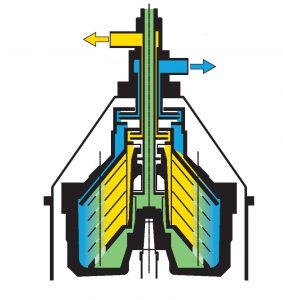
In the case of the LHZ series centrifugal pump, the two phases to be mixed are pumped jointly into a rotating mixing bowl (2), where they are accelerated to the circumferential velocity of the bowl. The centripetal pump (3) discharges the liquid mixture from the mixing bowl. The two phases are mixed intensively in the channels of the centripetal pump. The mixed liquid is then discharged from the mixer at outlet (4).
The pressure in the discharge line is adjusted with the aid of a throttling valve; this affects the suspension in such a way that the channels of the centripetal pump are immersed under the surface of the suspension and prevent any air intake. The hermetic version is the standard version for gas-tight applications. A slide ring packing ensures a hermetic seal between the bowl and the hood. The slide ring packing consists of a stainless-steel housing slide ring and a counter-ring made of hard carbon.
The output of the three-phase AC motor is transferred directly from the horizontal motor shaft to the mixer bowl. The variable speed mixer with a frequency converter drive is a further development. In this solution, a frequency converter can be used for infinite electric adjustment of phase mixing. The mixing characteristics can accordingly be adjusted individually, and this aspect is of great importance particularly in the case of “multi-purpose” applications. The drop size and the required turbulence vary as a function of the speed. The frequency converter enables the performance of the mixer to be adjusted at any time.


 The tubular centrifuge is consisted of frame body, driving device, bowl and motor.

 Huading continually raises the bar in bag filter technology. Providing the widest range of bag filters for any baghouse collector, Huading offers various bags.

 Vertical Pressure Leaf Filters are quite similar to the Horizontal Plate Filters except for the orientation of the filter elements which are vertical rather than horizontal. They are applied for the polishing slurries with very low solids content of 1-5% or for cake filtration with a solids concentration of 20-25%.






 In the case of the LHZ series centrifugal pump, the two phases to be mixed are pumped jointly into a rotating mixing bowl (2), where they are accelerated to the circumferential velocity of the bowl. The centripetal pump (3) discharges the liquid mixture from the mixing bowl. The two phases are mixed intensively in the channels of the centripetal pump. The mixed liquid is then discharged from the mixer at outlet (4).