
The Role of Decanter Centrifuges in Drilling Fluid Solids Control
Sep 05,2026
Drilling fluid is one of the biggest operating costs on a drilling rig. As mud returns up the annulus, it carries drilled solids back to the surface. If those solids remain in the system, they increase treatment costs, drive up dilution requirements, and add to the volume of waste that must be handled or disposed of.
That is why solids control matters. The goal is to remove unwanted solids as efficiently as possible while preserving as much usable drilling fluid as possible. In a typical solids control system, the decanter centrifuge handles the finer particles that upstream equipment cannot remove.
Its performance, however, depends on more than simply having a centrifuge in the flow line. Where it is installed, how it is operated, the mud properties, feed rate, bowl speed, and separation settings all affect the result. Understanding those factors is key to determining how much value a centrifuge can actually deliver on a drilling operation.
Why the Final Stage Matters Most
Shale shakers remove the larger cuttings first, while desanders and desilters deal with smaller particles farther down the solids-control train. By the time the mud reaches the final stage, most of the obvious solids are already gone. What remains is harder to deal with: fine, low-gravity solids that stay suspended in the fluid and gradually build up over time.
Left unchecked, these fines increase mud viscosity, raise treatment and dilution requirements, and can contribute to lower drilling rates. They are simply too small for conventional shaker screens, and hydrocyclones become less effective as particle size and density differences decrease.
This is where the decanter centrifuge becomes useful. Instead of relying on screen size, it uses centrifugal force and density differences to separate fine solids from the liquid phase. The solids are discharged as a concentrated underflow, while the recovered liquid can be returned to the mud system when conditions allow.
On the rig, the benefit is fairly straightforward. Better removal of fine solids means less dilution, lower demand for fresh drilling fluid, and less liquid waste to haul away or dispose of. Those are usually more meaningful measures of centrifuge performance than the machine’s rated throughput alone.
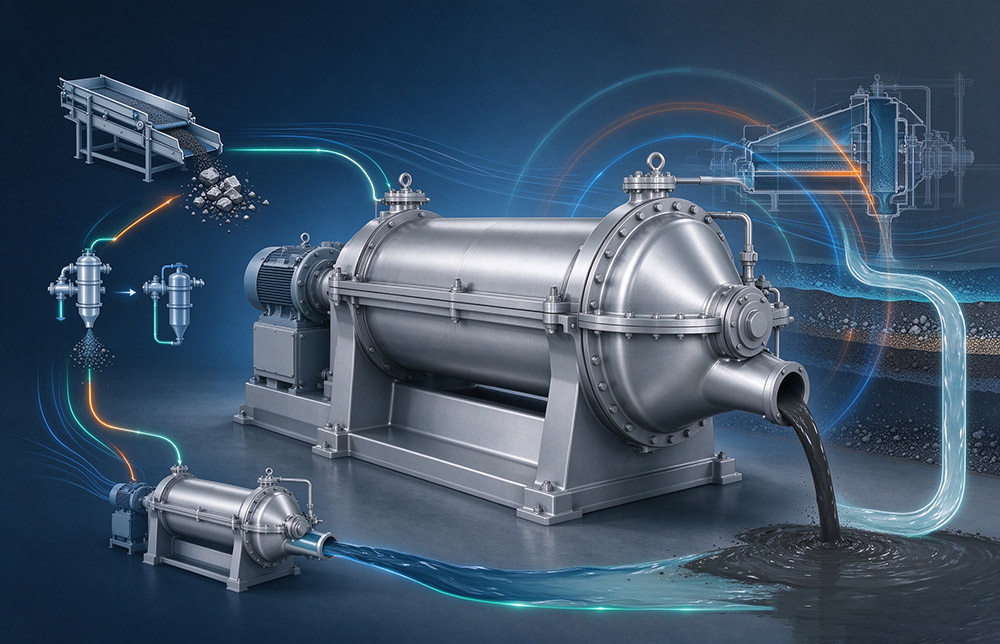
The Solids Control Train, in Order
Shale Shakers
First line of defense. They remove the largest cuttings and protect everything downstream.
Sand Traps & Desanders
Gravity and hydrocyclones take out coarse solids that pass the screens.
Desilters
Smaller hydrocyclones for the finer fraction.
Decanter Centrifuge
The final stage, and the only one that can both recover the weighting agent and produce solids dry enough to manage as a solid rather than a liquid.
Mud cleaners sit between the shaker and the desilter, combining a screen with a cyclone. The centrifugal stage is almost always last, because anything removed upstream should be simple and cheap to remove. Sending coarse solids through a centrifuge wastes its capacity and accelerates wear.
How a Decanter Centrifuge Treats Drilling Mud
Drilling mud enters the centrifuge through a stationary feed pipe and is accelerated inside the rotating bowl. As the bowl spins, the heavier solids are forced toward the bowl wall, where they form a settled layer. A screw conveyor turns at a slightly different speed from the bowl and continuously moves those solids toward the conical end of the machine. They travel up the beach and discharge through the solids ports, while the separated liquid leaves from the opposite end.
How clean that separation is depends heavily on how the centrifuge is set up. Bowl speed affects the centrifugal force available for separation and, in general, higher speeds allow the machine to capture finer particles. The speed difference between the bowl and conveyor controls how quickly settled solids are moved through the machine. Pool depth and feed rate also matter, since both influence residence time, liquid clarification, and how dry the discharged solids will be. These settings are normally balanced against one another rather than adjusted in isolation.
That balance becomes especially important when the mud contains barite. Barite is used to build drilling-fluid density and has a much higher specific gravity than the clays and drilled solids that contaminate the system. A properly operated centrifuge can take advantage of that density difference, but the operating objective determines what happens to the separated material.
In barite-recovery service, the heavier barite-rich fraction is collected so that valuable weighting material can be returned to the active mud system. In other applications, the centrifuge may be set up to remove fine solids from the fluid and discard the concentrated solids stream. The distinction matters. Running every centrifuge simply as a waste-removal machine can send usable weighting material out with the discarded solids, increasing both mud-treatment costs and waste volumes.
Operating for Barite Recovery or Dewatering
The same machine is asked to do two different jobs in drilling service, and the settings are not the same.
Barite Recovery
Barite recovery runs at a moderate bowl speed with a comparatively high differential. The aim is to move material through quickly and return the denser underflow, barite included, to the active system, while sending the lighter overflow on for further treatment. The objective is to hold the mud weight and keep the weighting agent in circulation.
Mud Dewatering
Dewatering is the opposite instinct. It runs at the highest practical speed with a deeper pool, and a flocculant is normally dosed into the feed line ahead of the machine so that fine particles bind into larger flocs the centrifuge can capture. The underflow comes out as a cake dry enough to handle with a loader, and the centrate is clean enough to be reused or sent to disposal. On a zero-discharge site, that recovered water is often the difference between one tanker load a week and three.
Because the two duties pull in opposite directions, larger mud systems commonly run two machines in sequence: a recovery centrifuge protecting the mud inventory, followed by a dewatering centrifuge handling what is left.
Three-Phase Separation for Oily Waste and Slops
Not every stream coming off a drilling location is mud. Tank bottoms, slops, wash water from oil-based cuttings, and produced water all contain oil that has a value and a disposal cost. A three-phase separating decanter splits oil, water, and solids in a single machine, with the light phase discharged through a centripetal pump or a comparable arrangement and the heavy phase leaving separately.
When the oil droplets are fine and the solids load is low, a disc stack separator is often a better fit than a decanter, because the stack adds settling area and sharpens the liquid-liquid split. Machines that combine a disc stack ahead of the liquid outlet in a decanter bowl exist for exactly the middle ground between the two. In practice, an oilfield waste treatment line may use all three: decanter for the heavy solids, disc machine for the fine oil and water polish, and filtration for the final polish.
Huading builds separators, decanters, and complete treatment lines for this part of the industry, and lists drilling fluid treatment, oil sludge processing, and oil-water-solids mixtures among the core duties of its centrifuges for the energy industry.
Key Specifications for Centrifuge Selection
Solids Loading & Feed Rate
A unit sized on average flow will not cope with the peak, which is where separation quality collapses.
Target Cut Point
Decide whether the duty is recovering weighting agent, removing low-gravity fines, or producing a stackable cake. Each implies different speed and pool depth settings.
Wear Protection
Barite is abrasive. Wear-resistant materials and replaceable protection on the bowl and conveyor are what keep the machine in service between overhauls.
Intelligent Automation
A PLC with an HMI allows automatic mode settings, sludge dryness adjustments, and alarm monitoring, and adjustable solid transport speed lets the operator respond to changing solids load without stopping production.
Discharge Port Geometry
Vortex discharge ports raise processing capacity, reduce sludge fragmentation, and cut flocculant consumption, which matters on a dewatering duty where polymer is a running cost.
Drive & Gearbox Configuration
Planetary, hydraulic differential, and cycloid gearboxes each suit different duty profiles, and the choice affects how the differential speed behaves under load.
Maintaining Centrifuge Reliability
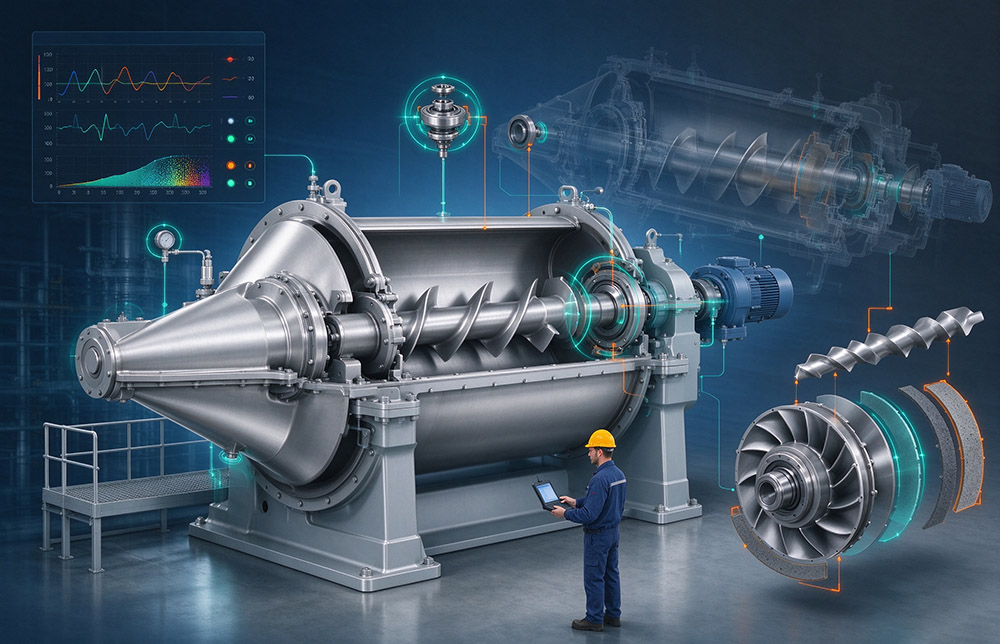
Most centrifuge problems come down to wear and routine mechanical issues rather than the separation process itself. The components that usually have the biggest effect on service life are the scroll and bowl surfaces, feed and discharge areas, main bearings, and the lubrication and drive systems.
Regular operating records are just as important as scheduled maintenance. Tracking cake dryness, centrate clarity, vibration, and other key operating data makes it easier to spot changes before they turn into downtime. A gradual loss of performance is much easier to address when there is a clear operating history to compare against.
Current decanter designs can make that work simpler. Replaceable wear parts, modular bowl and conveyor components, and controls that record operating conditions help maintenance teams identify problems faster and reduce the amount of time spent troubleshooting in the field.
Conclusion
Before buying, test the centrifuge on the mud it will actually handle. Solids type, density, viscosity, and chemistry all affect separation performance, and a machine that looks right on paper may need different settings in the field.
It is also worth checking the supplier’s track record on similar mud systems, wear-parts availability, and the level of operating and troubleshooting support provided. Over time, these factors can matter as much as the equipment specification itself.
Good solids control is ultimately about protecting the mud system. Coarse solids should be removed as early as possible, while the centrifuge handles the finer fraction that upstream equipment cannot capture efficiently.
Those fine solids can drive dilution, chemical use, and waste volume. A properly selected and operated centrifuge completes the solids-control process, and its real value is reflected in the condition and cost of the mud system over time.
--- END ---


