
The Role of Centrifugal Separation in Food Waste Processing
Sep 20,2026
Food waste is one of the largest single streams that cities, hotels, restaurants, and food processing plants have to manage. It is heavy, it is wet, and it starts to break down within hours of collection. Sent to landfill, it produces methane and leachate. Treated properly, the same material yields recovered oil, biogas, and a solid fraction that can be digested or composted.
Which of those two outcomes you get usually comes down to separation. The organic fraction of food waste is mostly water, with fats and oils dispersed through it and solids suspended in the mix. Gravity settling cannot handle a stream like that on its own, because the oil is emulsified and much of the solid load is fine. Centrifugal separation is what makes the split practical at industrial throughput.
This article looks at how a food waste treatment line is put together, where centrifuges do work that other equipment cannot, and what matters when selecting a machine for the duty.
What Food Waste Contains, and Why It Is Difficult to Treat
Food waste is not a uniform product. It is water-dominant, carries fats and oils, salt, and suspended organic solids, and it arrives with contamination that has nothing to do with the process: packaging film, cutlery, string, bones, and the occasional stone. The stream from a hotel kitchen on a Saturday does not look like what a vegetable processing plant delivers on a Tuesday.
Three outputs are normally wanted from the material. The first is a recovered fat and oil stream, which has value as a feedstock. The second is a liquid phase that has to be cleaned before it is discharged or reused. The third is a solids fraction that can go to digestion, composting, or drying.
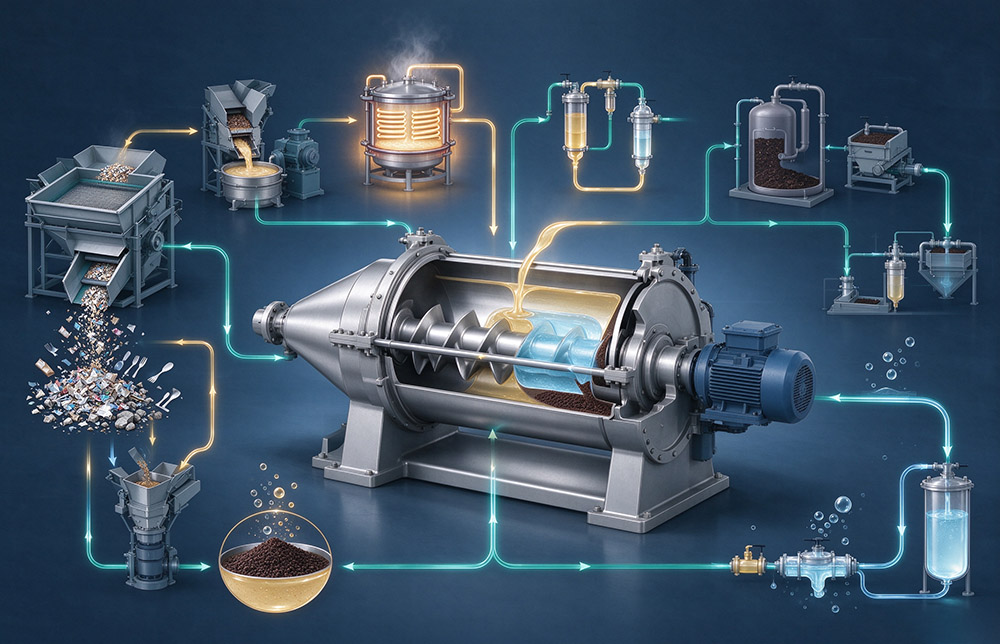
The Solids Control Process
Reception & Sorting
Packaging, plastics, cutlery, and stones are removed first. Coarse contamination protects every machine downstream.
Size Reduction
Crushing and grinding release the liquid and oil held inside the material and turn it into a slurry the rest of the line can pump.
Heating & Sterilization
Heat treatment sanitizes the material and lowers the viscosity of the fats so that they can separate from the water phase.
Three-Phase Separation
The centrifuge splits oil, water, and solids in a single pass, which is the step the rest of the line depends on.
Oil Polishing
Residual water and fine solids are taken out of the fat stream to bring it up to the quality a buyer will accept.
Solids Processing
The organic solids go to anaerobic digestion or composting, and the digestate still has to be dewatered before it leaves the site.
Water Treatment
Oil remaining in the liquid phase is removed before the water is reused or discharged.
Where the Centrifuge Does the Work
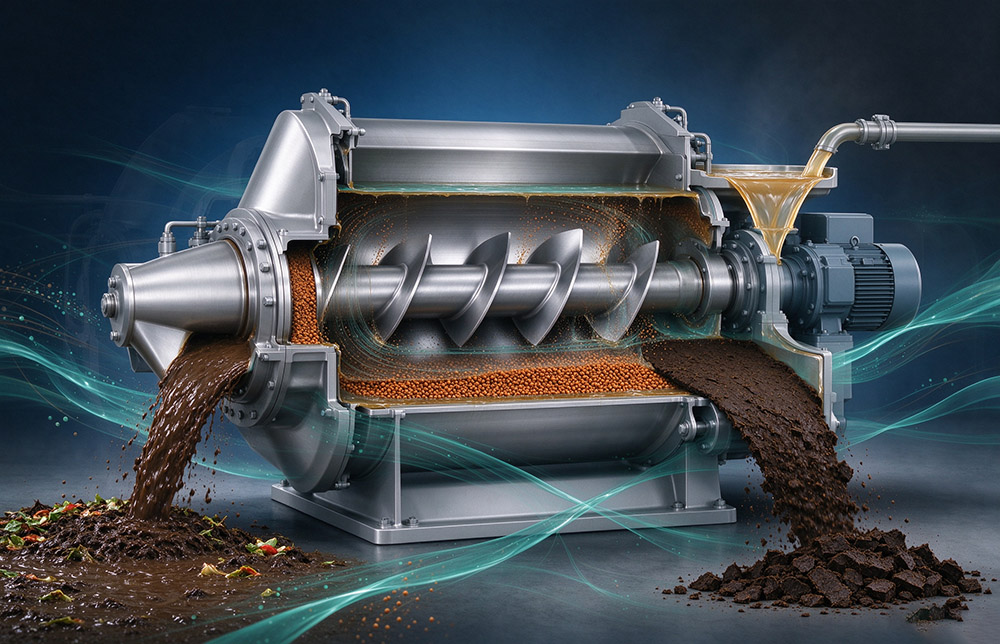
The three-phase separating decanter is the machine that carries the load in most food waste lines. Slurry enters through a stationary feed pipe and is accelerated inside a bowl spinning at high speed. The centrifugal field drives the densest material, the solids, against the bowl wall, where a screw conveyor turning at a slightly different speed moves them along the beach and out through the discharge ports. Between the bowl wall and the center, the two liquid phases separate according to their densities.
For that to work, three conditions have to hold. The two liquid phases must be immiscible, they must have different densities, and the solid phase must have the highest specific gravity of the three. Food waste satisfies all three. Liquid discharge is handled in several ways: in one common arrangement, a centripetal pump discharges the light phase while the heavy phase leaves by gravity.
The practical advantage of doing this in one machine is that it removes the need for additional separation stages, which is where a large part of the cost of a food waste line otherwise sits. A three-phase separating decanter performs continuous three-phase separation in a single process, and interchangeable weir plates let the operator adjust the liquid level when the feed composition changes.
Recovering the Oil Fraction
The fat and oil fraction is the highest-value output of the process. Used cooking oil and recovered food-grade fats are traded as feedstock for biodiesel and oleochemical production, which means the quality of the separation has a direct effect on what the material is worth. Water carried over with the fat, fine solids, and salt all reduce that value and increase the cost of the downstream refining step.
Modern oil and fat recovery processes rely on centrifugal clarifying and separating technology because the machine is continuous, closed, and able to handle an emulsion that would otherwise need chemicals and time to break. Clarification of frying fat is one of the standard applications in this part of the industry, alongside recovery duties where the raw material arrives as flotation sludge or as process residue.
Where the fat stream is being brought up to specification, a disc separator is often used after the decanter for the final liquid-liquid polish, and self-cleaning versions in steam-sterilizable design are available where the process is heated and hygiene matters. Machines of this type are built to hygienic design principles, which is a requirement rather than an option when the oil is destined for food or feed use.
Dewatering the Solids and the Digestate
The solids side of a food waste line is where volume, and therefore cost, accumulates. Whether the organic fraction goes to digestion or composting, it comes out as a wet residue. The solids concentration in that residue decides how much has to be moved, how much energy drying or incineration needs, and the disposal cost per ton.
Dewatering is the step that sets those numbers. A decanter compacts the solids under centrifugal force and expels the residual liquid, producing a cake that can be handled as a solid, with the clarified liquid leaving through an overflow weir. The drier the cake, the smaller the volume to transport and the greater the saving on haulage, landfill, and drying fuel.
The same duty applies to dewatering of sludge and digestate, where the economics are dominated by the degree of dewatering achieved rather than by throughput alone. A machine that runs faster but leaves a wetter cake can cost more to operate than a slower unit that discharges a drier one.
What Makes a Centrifuge Suitable for Food Waste Duty
Hygienic Design
Hygiene requirements are especially stringent in the food and beverage industry, and machines are built accordingly, including steam-sterilizable designs for heated processes.
Wear Protection
Food waste carries sand, bone fragments, and small stones. Application-specific wear protection on the bowl, conveyor, and discharge areas is what keeps the machine in service.
Adjustable Liquid Level
Interchangeable weir plates or energy recovery discharge elements let the operator respond to changes in feed composition without stopping the line.
Intelligent Control Integration
A PLC with an HMI provides automatic mode settings, sludge dryness adjustment, and alarm monitoring, and actuator-controlled impellers remove much of the manual intervention from a process that runs continuously.
Material Selection
Salt content makes corrosion a real consideration, so wetted parts need to be chosen for the stream rather than for a general specification.
Diverse Equipment Portfolio
A decanter handles the high-solids slurry, a disc separator handles the fine liquid-liquid polish, a tubular centrifuge handles very fine clarification, and a screw press or filter handles the final solids dewatering. A line usually needs more than one type.
Operating Notes
The most common cause of poor separation in a food waste plant is not the machine but the feed. Composition shifts with the season, the collection route, and the kitchen the material came from, and settings that worked on one day’s feed will not necessarily hold on the next. Feed rate, bowl speed, differential speed, and pool depth have to be treated as variables to be adjusted rather than fixed values.
Records are the practical answer. Tracking cake dryness, centrate clarity, and oil quality makes a gradual decline visible while it is still a small problem. Most failures trace back to wear on the scroll, bowl, feed and discharge areas, or to the bearings, lubrication, and drive systems, and those show up first in operating data.
Conclusion
Before making a final equipment choice, it is worth testing the centrifuge on the material it will actually process. Food waste can vary considerably in solids content, oil concentration, viscosity, and composition, and those differences have a direct effect on separation performance.
Supplier experience also matters. Comparable installations, reliable access to wear parts, and practical operating support all become important once the equipment is running day after day.
In the end, the centrifuge is only one part of the treatment line, but it has a major influence on what the process is able to recover. By removing the finer material left after the upstream stages, it helps improve oil recovery, produce a drier solids stream, and reduce the amount of material that still needs to be handled as waste.
That is where its value is best measured: not simply by throughput, but by the quality of the recovered products and the overall efficiency of the process.
--- END ---
Prev: The Role of Decanter Centrifuges in Drilling Fluid Solids Control
Already the latest article


