
Treatment of Chicken Embryo Allantoic Fluid: Improving Vaccine Manufacturing Efficiency
Jul 23,2026
The treatment of chicken embryo allantoic fluid plays a vital role in egg-based vaccine production. For decades, embryonated chicken eggs have been widely used to cultivate influenza viruses, Newcastle disease virus, and other viral strains for both human and veterinary vaccines. After incubation, the harvested allantoic fluid contains not only the target virus but also egg proteins, membrane fragments, blood cells, and suspended solids that must be removed before downstream purification.
As vaccine manufacturers continue to increase production capacity while meeting stricter quality standards, the clarification stage has become more important than ever. Selecting the right separation technology not only improves product consistency but also reduces downstream processing costs and enhances overall manufacturing efficiency.
Among the available solutions, high-speed disc stack separators have become the preferred choice for continuous clarification of biological fluids because they combine efficient solid-liquid separation with hygienic operation and gentle product handling.
Why Is Chicken Embryo Allantoic Fluid Treatment So Important?
In egg-based vaccine production, the quality of harvested allantoic fluid directly influences every downstream operation. If excessive impurities remain in the liquid, they can quickly overload filtration systems, reduce purification efficiency, and increase manufacturing costs.
Clarification is not simply a cleaning step—it establishes the foundation for the entire downstream process. Efficient removal of suspended solids creates a more stable feed stream for ultrafiltration, chromatography, and sterile filtration while helping manufacturers achieve consistent product quality.
As production volumes continue to grow, manual clarification methods are no longer sufficient. Modern vaccine facilities require automated separation systems capable of processing large quantities of biological fluid while maintaining sterile operating conditions.
Key Challenges in Allantoic Fluid Clarification
Although allantoic fluid appears relatively clear, it contains a complex mixture of biological materials that present several processing challenges.
Preserving Virus Integrity
Unlike many industrial liquids, vaccine intermediates contain highly sensitive viral particles. Excessive mechanical force during clarification may reduce virus recovery or affect biological activity. Separation equipment must therefore provide efficient clarification while minimizing shear stress.
Removing Fine Biological Impurities
Harvested allantoic fluid contains proteins, membrane fragments, blood residues, and microscopic tissue particles. These contaminants vary significantly in size and density, making complete separation more difficult than conventional liquid clarification.
Maintaining Hygienic Production
Pharmaceutical manufacturing requires strict contamination control throughout the production process. Equipment must support enclosed operation, automated cleaning, and sterilization to reduce contamination risks while complying with GMP manufacturing standards.
Supporting Large-Scale Production
Commercial vaccine manufacturers often process thousands of liters of biological fluid each day. Clarification equipment must operate continuously with stable separation performance and minimal downtime to maintain production efficiency.
Comparing Clarification Technologies
Several technologies are available for treating chicken embryo allantoic fluid, but each offers different advantages depending on production requirements.
| Separator Feature | Operational Benefit | Business Value |
|---|---|---|
| Continuous operation | Stable clarification throughout production | Higher productivity |
| Low-shear separation | Protects sensitive viral particles | Improved product recovery |
| Automatic solids discharge | Minimizes production interruptions | Lower labor costs |
| CIP/SIP hygienic design | Simplifies cleaning and sterilization | Supports GMP compliance |
| Fully enclosed system | Reduces contamination risk | Improved product quality |
| Scalable processing capacity | Supports pilot to commercial production | Flexible investment for future expansion |
In modern vaccine manufacturing, disc stack separators are commonly installed before fine filtration. By removing most suspended solids during primary clarification, they significantly reduce filter loading and improve the efficiency of downstream purification.
Why Disc Stack Separators Are the Preferred Solution?
Disc stack centrifuges use high centrifugal force to separate suspended particles from biological fluids in a continuous process. Their compact disc configuration creates a large settling area inside the separator, enabling efficient clarification even when processing fluids containing fine particles.
Compared with filtration-only systems, disc stack separators handle higher solids concentrations without frequent interruptions. They also reduce membrane fouling, extend filter service life, and improve overall production stability.
Another important advantage is their enclosed hygienic design. Pharmaceutical-grade separators can operate as part of a closed production system, minimizing exposure to the surrounding environment and helping manufacturers maintain sterile processing conditions throughout the clarification stage.
Because of these advantages, disc stack centrifuges have become standard equipment in many vaccine production facilities worldwide.
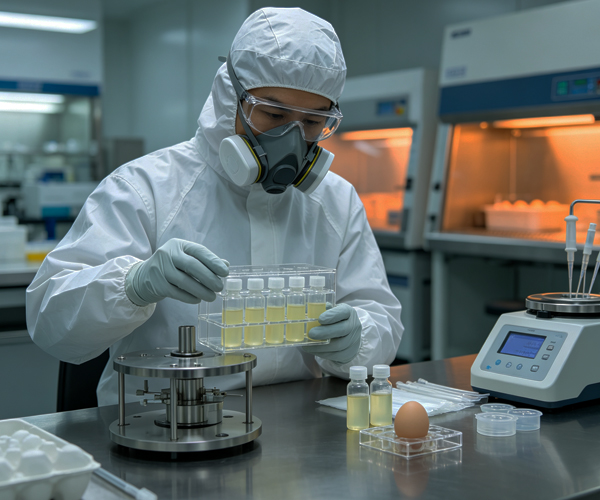
Huading Separator Solutions for Vaccine Processing
Huading Separator specializes in centrifugal separation systems for pharmaceutical, biotechnology, and biological manufacturing applications. Our disc stack separators are engineered to meet the demanding requirements of vaccine production, combining reliable separation performance with hygienic equipment design.
Each system features a fully enclosed stainless-steel construction designed for pharmaceutical environments. Integrated Clean-in-Place (CIP) and Steam-in-Place (SIP) functions allow the separator to be cleaned and sterilized without disassembly, reducing downtime while maintaining process safety.
Automatic solids discharge enables continuous operation during long production cycles, while optimized disc stack geometry provides efficient clarification with low shear characteristics. This design helps preserve sensitive biological materials while delivering consistent separation performance across different production capacities.
Whether supporting pilot-scale vaccine development or commercial manufacturing, Huading separators provide scalable solutions that improve downstream efficiency and process reliability.
Benefits of Using Disc Stack Separation
The advantages of disc stack separation extend beyond simple clarification. For vaccine manufacturers, the technology contributes to higher production efficiency, lower operating costs, and more reliable product quality.
| Benefit | Value for Vaccine Manufacturing |
|---|---|
| Continuous clarification | Supports uninterrupted production |
| Low-shear separation | Helps preserve sensitive viral particles |
| Reduced filter fouling | Extends membrane and filter service life |
| Hygienic enclosed design | Minimizes contamination risk |
| Automatic operation | Reduces manual labor and maintenance |
| Scalable capacity | Suitable for both pilot-scale and commercial production |
These benefits make disc stack separators an important component of modern pharmaceutical downstream processing.
Applications Beyond Allantoic Fluid
Although widely used for the treatment of chicken embryo allantoic fluid, disc stack separators are suitable for many other biological separation processes. They are commonly applied in microbial fermentation, recombinant protein production, enzyme manufacturing, cell culture harvesting, plasma fractionation, probiotic production, and biotechnology research.
Conclusion
As vaccine production continues to evolve, efficient clarification has become an essential part of downstream processing. Proper treatment of chicken embryo allantoic fluid improves product quality, protects downstream purification equipment, and helps manufacturers achieve stable, cost-effective production.
High-speed disc stack separators provide a reliable solution by combining continuous clarification, hygienic operation, and gentle product handling in a single system.
With decades of experience in centrifugal separation technology, Huading Separator delivers customized disc stack separator solutions for pharmaceutical and biotechnology applications. From pilot-scale laboratories to large commercial vaccine facilities, our equipment is designed to improve separation efficiency while supporting the highest standards of process reliability and product quality.
FAQ
-
What is chicken embryo allantoic fluid used for?
Chicken embryo allantoic fluid is widely used in egg-based vaccine production because it provides an ideal environment for cultivating viruses such as influenza and Newcastle disease virus.
-
Why is clarification necessary before purification?
Clarification removes suspended solids and biological impurities, reducing the load on downstream filtration systems and improving purification efficiency.
-
Why are disc stack separators preferred for vaccine manufacturing?
Disc stack separators provide continuous, low-shear clarification while maintaining hygienic processing conditions, making them ideal for pharmaceutical production.
-
Can Huading separators support GMP manufacturing?
Yes. Huading disc stack separators feature enclosed construction, CIP/SIP capability, and automatic solids discharge, making them suitable for GMP-compliant pharmaceutical and biotechnology facilities.
--- END ---


