

Why Centrifuge Beer?
Traditional solid-liquid separation methods allow particulate matter to settle naturally at the bottom of a conical fermenter, a process that can take a considerable amount of time.
After settling, the young beer is transferred to a maturation tank via a racking arm located above the settled yeast and hop layer within the conical fermenter. However, a significant amount of high-quality beer is typically lost with the sediment during the final removal of solid particles.
For craft breweries, this loss can be even greater, given the extensive use of hops in various beer styles.
Even after cold maturation, beer may still contain residual yeast, hop residue, proteins, and other turbidity-causing compounds. Traditionally, breweries use diatomaceous earth filters, candle filters, plate filters, or canister filters to remove these particles. However, these systems typically have limited solid-liquid separation capabilities, are slow to filter, and are costly to maintain and clean.
In contrast, brewing centrifuges utilize centrifugal force, gently accelerating the solids through a rotating drum and an internal array of discs.
Centrifuges operate at thousands of revolutions per minute, creating a larger settling area that allows for rapid clarification and efficient removal of unwanted yeast, hops, and protein solids from beer in a very short time. Therefore, centrifugation has become a mature and reliable beer clarification and refining technology.
Centrifugation helps professional brewers improve brewing stability and product quality, accelerate tank turnover, and reduce product loss. Compared to traditional filtration systems, centrifuges also better retain aroma compounds and volatile flavor substances, while giving brewers better control over the contact time of raw materials.
These advantages are particularly important for craft brewers experimenting with new plant ingredients and flavor combinations to meet consumer demand for innovative beer styles and premium products.
Equally important, a well-designed centrifuge helps minimize oxygen absorption during processing. This contributes to producing beers with longer shelf lives, superior quality, and high stability, while reducing the risk of off-flavors and colloidal instability caused by oxidation and reactions between oxygen, proteins, and polyphenols.
How Does a Beer Centrifuge Work?
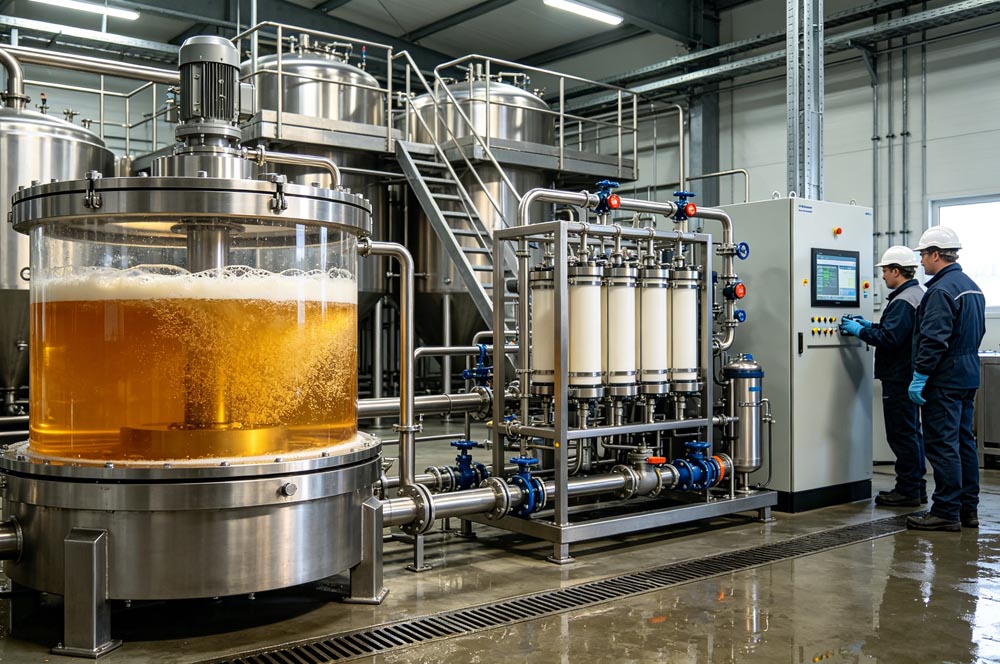
The basic principle of centrifugation stems from the natural sedimentation process that occurs in a settling tank: particles, precipitates, and solids gradually sink to the bottom, while liquid phases of different densities separate under gravity.
Unlike filtration, which separates based on particle size, centrifugation separates based on particle density and mass. Slight acceleration within the centrifuge bowl, combined with the rotation of an internal array of discs, physically separates heavier particles from the liquid.
Centrifugal brewing systems continuously separate liquid and solid phases in a continuous, uninterrupted process. The type of centrifuge commonly used in breweries is called a disc separator.
The working principle of a disc separator is: centrifugal force is applied to the denser solids, pushing them against the walls of the rotating bowl, while the less dense liquid phase forms a concentric inner layer.
The boundary between these two liquid phases is called the interface. By adjusting the interface, brewers can optimize separation efficiency. An increased interface area significantly reduces the time required to remove solid impurities such as yeast, hops, and proteins from beer.
The heavier solid phase accumulates at the outer edge of the bowl and is intermittently ejected by centrifugal jets. Solids are discharged by a hydraulic system located below the separation chamber, which lowers the bottom of the sliding at controlled intervals, thereby opening solid discharge ports around the bowl.
What Is the Difference Between Beer Filtration and Centrifugation?
Centrifugation is a mechanical separation process that removes particles based on their density and mass. Lighter particles are generally more difficult to separate. Filtration, on the other hand, separates particles based on their size. These two technologies complement each other.
In brewing applications, centrifugation is typically performed before filtration, especially when extended shelf life is required. If the beer is intended for export or long-term storage in supermarkets, filtration is still necessary to prevent cold turbidity over time.
However, for unfiltered beers with fast inventory turnover, centrifugation alone can be an excellent solution. This method helps retain more of the beer’s natural aromas and volatile flavor compounds while effectively clarifying it.


