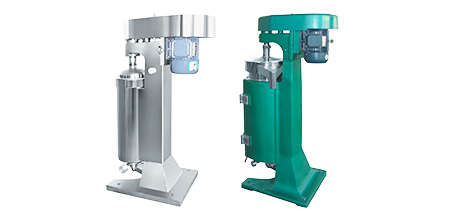
Why Can’t a Centrifuge Separate Saltwater?
To answer this question, we need to look at two key points: first, how a centrifuge works; and second, why saltwater is considered a homogeneous solution. By understanding these two aspects, it becomes clear why centrifugation cannot separate dissolved salt from water.
How Does a Centrifuge Work?
A centrifuge works by spinning a mixture at very high speed to generate centrifugal force. This force pushes substances outward, away from the center of rotation. In effect, it strengthens the influence of gravity, making it much easier to separate materials that differ in density or particle size.
In a centrifuge, denser components are pushed toward the outer edge of the container, usually against the walls or bottom of the centrifuge tube. Less dense components remain closer to the center.
This method is highly effective for mixtures whose components remain physically separate and do not fully blend into one another. In such cases, centrifugation simply speeds up a separation process that gravity could eventually achieve on its own. What might take hours through natural settling can often be completed in seconds or minutes using a centrifuge.
Saltwater Is a Homogeneous Solution
Unlike muddy water or an oil-and-water mixture, saltwater is a homogeneous solution. This means the salt, or sodium chloride, is not just suspended in the water. Instead, it is completely dissolved at the molecular or ionic level.
When salt dissolves in water, sodium chloride breaks apart into sodium ions, Na⁺, and chloride ions, Cl⁻. These ions become evenly distributed among the water molecules.
Because the salt no longer exists as solid crystals or visible particles, there are no distinct particles for a centrifuge to push outward. There are also no separate layers or clear phase boundaries for the centrifuge to act on.
Even if saltwater is spun at very high speed, it remains a single, uniform liquid. The dissolved ions move together with the water rather than separating from it. As a result, centrifugation cannot effectively separate salt from water.
The Difference Between Solutions and Suspensions
Solution: Saltwater
A solution is a homogeneous mixture in which the solute is completely dissolved in the solvent at the molecular or ionic level.
In saltwater, the solute is salt and the solvent is water. Sodium ions and chloride ions are uniformly distributed throughout the liquid. Because there are no independent solid particles, a centrifuge has nothing visible or solid to force outward and collect.
Suspension: Muddy Water
A suspension is a heterogeneous mixture in which solid particles are dispersed in a liquid but are not dissolved.
In muddy water, soil, clay, or other solid particles remain suspended in the water. These particles are much larger than dissolved ions and can often reach the micron scale. Because of their size and mass, centrifugal force can act on them, pushing them outward and causing them to settle.
A centrifuge can separate mixtures when their components exist as different phases, particles, or layers. However, saltwater is a homogeneous solution in which salt is fully dissolved into ions and evenly distributed throughout the water.
Therefore, a centrifuge cannot separate saltwater into salt and pure water. To separate dissolved salt from water, methods such as evaporation, distillation, or reverse osmosis are usually required.
Are there any cases where a centrifuge cannot separate immiscible solids from liquids?
In some cases, centrifuges are unable to separate immiscible solids from liquids. Immiscible substances are substances that do not mix or dissolve with each other, such as oil and water.
When immiscible solids are mixed with a liquid, they can form a suspension in which the solid particles are dispersed throughout the liquid but not dissolved in it. While a centrifuge can separate the solids from the liquid by pushing the solids to the bottom of the container through centrifugal force, the process is not always effective at separating all the solids from the liquid.
For example, if solid particles are very small and of low density, they may remain suspended in a liquid even when subjected to high centrifugal forces. Also, if solid particles are viscous or firmly adhered to containers or other particles, they may not separate easily from the liquid.
Examples of other mixes that a centrifuge cannot separate
Here are some examples of other mixtures that a centrifuge may not be able to separate effectively:
Emulsion
An emulsion is a mixture of two immiscible liquids, such as oil and water, that are held together by an emulsifier. Emulsions can be difficult to separate because the liquids have similar densities and the emulsifier stabilizes the mixture. While a centrifuge can be used to separate emulsions, it may not effectively separate all liquid phases due to the stability of the emulsion.
Fine Suspension
A fine suspension is a mixture of solid particles in a liquid in which the particle size is very small and the particles are evenly dispersed in the liquid. These mixtures can be difficult to separate because the particles are not large enough to settle out of the liquid, and they may remain suspended in the liquid even when subjected to high centrifugal forces.
Homogeneous Mixture
A homogeneous mixture is a homogeneously distributed mixture of substances, such as a solution. Since all components of a homogeneous mixture have similar densities, a centrifuge may not be able to separate them effectively. The separation of homogeneous mixtures is usually achieved by other methods such as distillation, evaporation, or chromatography.
Gas in Liquid
Centrifugation cannot effectively separate gas from liquid because gas is not affected by centrifugal force. In this case, other methods such as distillation, evaporation, or stripping are used to separate the gas from the liquid.