Sedimentation, Clarification, and Filtration in Brewing

Jun 04,2026

Sedimentation, clarification, and filtration are essential steps after fermentation to remove unwanted solids such as residual yeast, hop particles, and proteins in order to produce clean, clear beer.

Why Centrifuge Beer?

Traditional solid-liquid separation methods allow particulate matter to settle naturally at the bottom of a conical fermenter, a process that can take a considerable amount of time.

After settling, the young beer is transferred to a maturation tank via a racking arm located above the settled yeast and hop layer within the conical fermenter. However, a significant amount of high-quality beer is typically lost with the sediment during the final removal of solid particles.

For craft breweries, this loss can be even greater, given the extensive use of hops in various beer styles.

Even after cold maturation, beer may still contain residual yeast, hop residue, proteins, and other turbidity-causing compounds. Traditionally, breweries use diatomaceous earth filters, candle filters, plate filters, or canister filters to remove these particles. However, these systems typically have limited solid-liquid separation capabilities, are slow to filter, and are costly to maintain and clean.

In contrast, brewing centrifuges utilize centrifugal force, gently accelerating the solids through a rotating drum and an internal array of discs.

Centrifuges operate at thousands of revolutions per minute, creating a larger settling area that allows for rapid clarification and efficient removal of unwanted yeast, hops, and protein solids from beer in a very short time. Therefore, centrifugation has become a mature and reliable beer clarification and refining technology.

Centrifugation helps professional brewers improve brewing stability and product quality, accelerate tank turnover, and reduce product loss. Compared to traditional filtration systems, centrifuges also better retain aroma compounds and volatile flavor substances, while giving brewers better control over the contact time of raw materials.

These advantages are particularly important for craft brewers experimenting with new plant ingredients and flavor combinations to meet consumer demand for innovative beer styles and premium products.

Equally important, a well-designed centrifuge helps minimize oxygen absorption during processing. This contributes to producing beers with longer shelf lives, superior quality, and high stability, while reducing the risk of off-flavors and colloidal instability caused by oxidation and reactions between oxygen, proteins, and polyphenols.

How Does a Beer Centrifuge Work?
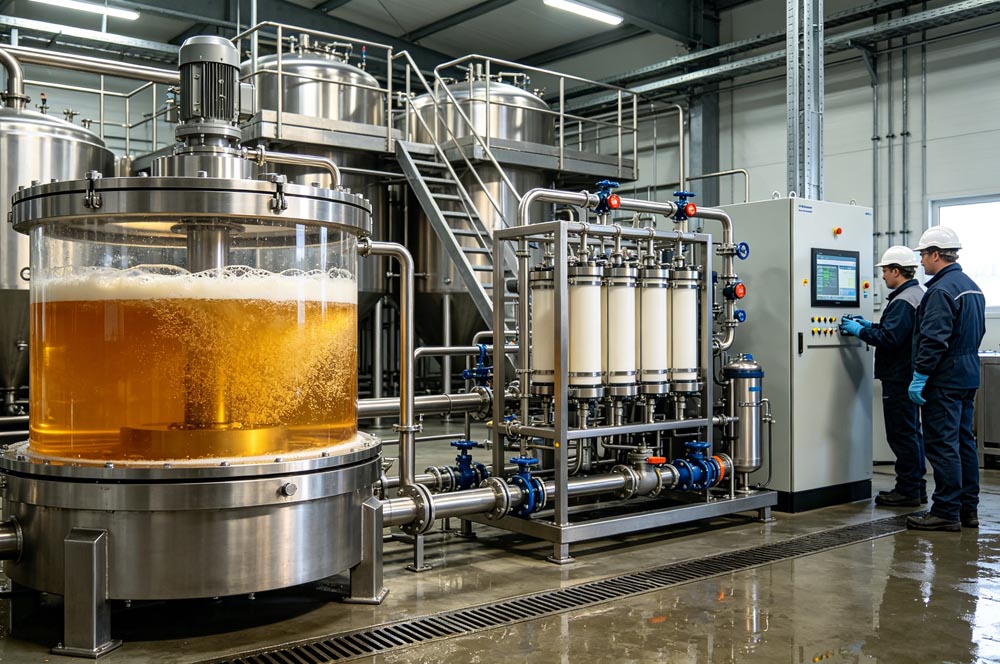
Sedimentation, Clarification, and Filtration in Brewing

The basic principle of centrifugation stems from the natural sedimentation process that occurs in a settling tank: particles, precipitates, and solids gradually sink to the bottom, while liquid phases of different densities separate under gravity.

Unlike filtration, which separates based on particle size, centrifugation separates based on particle density and mass. Slight acceleration within the centrifuge bowl, combined with the rotation of an internal array of discs, physically separates heavier particles from the liquid.

Centrifugal brewing systems continuously separate liquid and solid phases in a continuous, uninterrupted process. The type of centrifuge commonly used in breweries is called a disc separator.

The working principle of a disc separator is: centrifugal force is applied to the denser solids, pushing them against the walls of the rotating bowl, while the less dense liquid phase forms a concentric inner layer.

The boundary between these two liquid phases is called the interface. By adjusting the interface, brewers can optimize separation efficiency. An increased interface area significantly reduces the time required to remove solid impurities such as yeast, hops, and proteins from beer.

The heavier solid phase accumulates at the outer edge of the bowl and is intermittently ejected by centrifugal jets. Solids are discharged by a hydraulic system located below the separation chamber, which lowers the bottom of the sliding at controlled intervals, thereby opening solid discharge ports around the bowl.

What Is the Difference Between Beer Filtration and Centrifugation?

Centrifugation is a mechanical separation process that removes particles based on their density and mass. Lighter particles are generally more difficult to separate. Filtration, on the other hand, separates particles based on their size. These two technologies complement each other.

In brewing applications, centrifugation is typically performed before filtration, especially when extended shelf life is required. If the beer is intended for export or long-term storage in supermarkets, filtration is still necessary to prevent cold turbidity over time.

However, for unfiltered beers with fast inventory turnover, centrifugation alone can be an excellent solution. This method helps retain more of the beer’s natural aromas and volatile flavor compounds while effectively clarifying it.

Five Reasons Breweries Invest in a Beer Centrifuge

1. Increase Beer Yield and Reduce Product Loss

Traditional sedimentation methods often result in significant amounts of beer remaining in yeast and hop sediment, especially in craft beers with high dry-hop production. Centrifuges efficiently separate the solids and liquids, recovering more marketable beer and allowing breweries to maximize per-batch yield and improve overall profitability.

2. Faster Tank Turnover and Increased Capacity

Natural sedimentation and cold maturation can take days or even weeks to bring beer to packaging standards. Centrifuges can continuously remove yeast, hop particles, and proteins within hours, significantly reducing clarification time. Faster clarification means faster tank turnaround, higher brewing capacity, and greater operational flexibility without the need for additional fermentation tanks.

4. Minimize Oxygen Absorption, Extend Shelf Life

Oxygen exposure is one of the biggest threats to beer stability, leading to oxidation, flavor degradation, and turbidity. A fully enclosed centrifuge design helps minimize oxygen absorption during processing, resulting in more stable beer, extended shelf life, improved turbidity stability, and reduced risk of off-flavors.

5. Improve Process Consistency and Brewing Flexibility

Centrifuges allow brewers to more precisely control the clarification process and ingredient contact time, ensuring consistent quality across batches. Furthermore, centrifuges allow breweries to confidently experiment with higher hop counts, the addition of fruits, botanicals, and other specialty ingredients while maintaining efficient processing and product stability. This flexibility is particularly important for craft breweries responding to consumer demand for innovative and premium beer styles.

How to Choose the Right Centrifuge for Your Brewery?

Stability, quality, faster tank turnover, loss control, and better control over the contact time between feedstock and beer are all well-known advantages.

Choosing the right centrifuge size for your brewery is not easy, as there are numerous designs and manufacturers available. Key factors in selecting the right model include solids content, throughput, and your desired performance.

Solids Recovery

Craft breweries typically use more dry-hopped beer than conventional breweries, meaning more beer remains in the solids at the bottom of the fermentation tank. Depending on the solids concentration, often close to 50% of the valuable beer remains at the bottom.

Brewing centrifuges can help breweries recover most of this lost beer while improving overall process efficiency. Even small systems can significantly reduce beer loss and increase yield. In many applications, breweries can increase total beer recovery by 5% to 15%, depending on the recipe, hop amount, and solids content.

In addition to maximizing yield, centrifugation helps brewers shorten clarification time and maintain consistency in product quality across batches.

Meeting the Needs of Breweries of All Sizes

Modern brewing centrifuges are available in a variety of capacities to meet the needs of everything from small craft breweries to large commercial breweries.

Compact centrifuges are ideal for small breweries with only one or two fermentation tanks, providing efficient clarification without taking up too much production space.

Medium-sized systems offer the flexibility needed for growing craft breweries, while high-capacity industrial centrifuges handle large-volume production while maintaining continuous operation and stable performance.

With scalable processing capacity, from small-batch production to scales of hundreds of kiloliters per hour, breweries can choose systems that meet both current production levels and future expansion plans.

Longer Shelf Life and Better Beer Stability

Reducing oxygen exposure during clarification is crucial for maintaining beer freshness and flavor stability. A well-designed brewing centrifuge helps minimize oxygen absorption during separation, protecting beer from oxidation and preserving its intended flavor characteristics.

Lower dissolved oxygen levels also help reduce turbidity and colloidal instability caused by reactions between oxygen, proteins, and polyphenols. Ultimately, the beer will be clearer, more stable in taste, have a longer shelf life, and perform better during storage and transportation.

For breweries producing hop-flavored beers or those targeting a wider distribution market, centrifugation is an effective way to extend product stability while maintaining flavor quality.

Why Huading Separators?

Consumer demand for fresher-tasting, more hop-flavored beers is growing, putting increasing pressure on breweries to improve efficiency and product quality. Huading Separators offers a range of centrifugal separation solutions designed specifically for brewing applications, helping breweries optimize clarification performance while preserving the beer’s character and integrity.

As brewing technology continues to evolve, centrifugation is no longer just an optional upgrade, it’s becoming a key tool for breweries to improve efficiency, maintain product consistency, and remain competitive in the rapidly growing global beer market.

--- END ---

Online Consultation
error: Content is protected !!